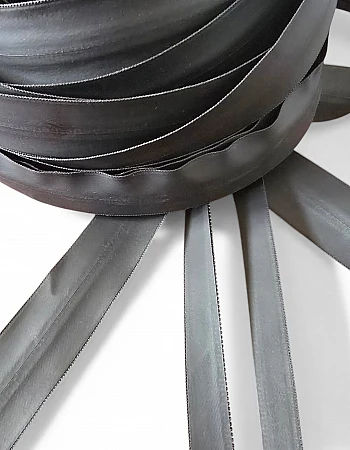
Water-Repellent Coated Zippers for Technical Production
Coated Zipper Sourcing for Technical Production
A coated zipper must be selected through its complete specification rather than the coating name alone. Zipper size, coil profile, film, end construction, slider count, fabric and manufacturing process all affect performance.
Approve the zipper in a finished sample that reflects the intended garment, bag or technical product construction.
Selection by Manufacturing Application
| Production Area | Zipper Approach | Production Check |
|---|---|---|
| Technical jacket and rainwear | #5 open-end coated zipper | Test centre-front length, bottom hardware, film and seam sealing. |
| Long outerwear | Two-slider combi coated zipper | Verify lower opening and both slider directions. |
| Outdoor bag and equipment case | Closed-end or coated continuous chain | Test corners, curves, slider junctions and end finishing. |
| Footwear and boots | Short coated zipper | Test repeated bending, abrasion and material contact. |
| Sampling and development | Individual ready-length or short chain quantity | Approve coating, color and sewing performance before bulk sourcing. |
Required Technical Specification
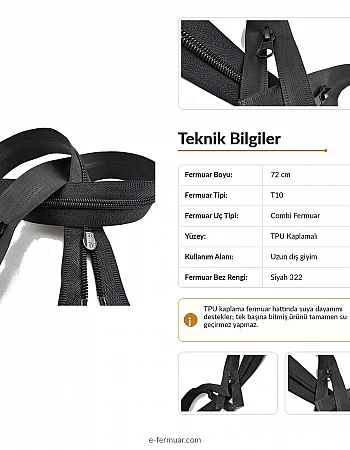
- Zipper size: #3, #5 or another verified profile
- Turkish size reference: Type 5, Type 10 or verified equivalent
- Coating: TPU, PU or another documented film
- End construction: Closed-end, separating, two-way or continuous
- Slider: Single slider, two sliders or one double-pull slider
- Functional length: Metric and imperial
- Sales format: Individual, package, metre or production quantity
- Verified performance: Test method and conditions where available
Water-Repellent and Waterproof Terminology
Use water-repellent or water-resistant for standard film-coated coil zippers unless a defined watertightness test has been verified.
A waterproof claim should identify the test method, pressure, duration, sample structure and exact configuration tested.
TPU and PU Film Inspection
TPU and PU descriptions do not provide a universal temperature, chemical or wash rating. Check the supplier technical data and test the approved production batch.
- Inspect the film for cuts, bubbles or separation.
- Check whether the slider scratches the coating.
- Observe whitening or cracking after repeated bending.
- Inspect film edges after sewing.
- Check the surface after heat, pressing or washing.
- Compare color and finish with the approved sample.
Separating and Two-Way Construction
A separating zipper allows both tape halves to detach and may use one slider.
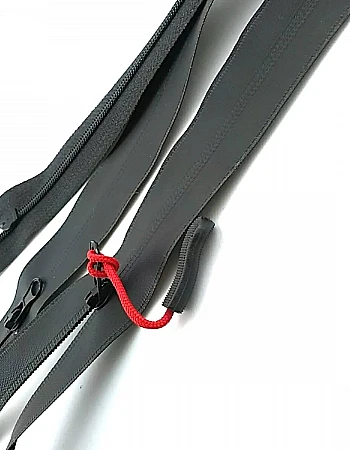
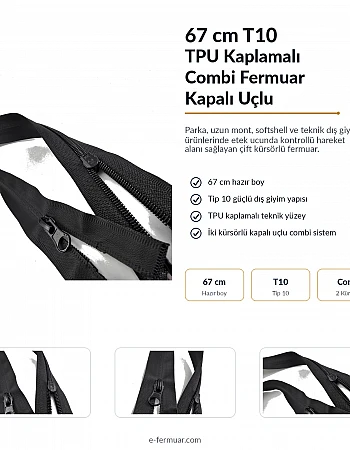
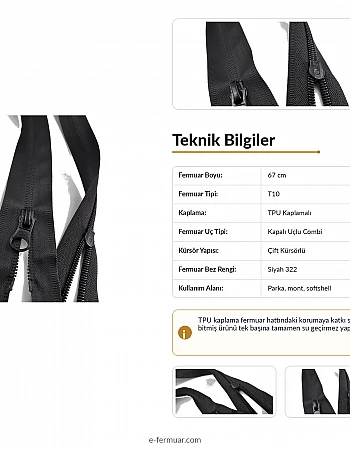
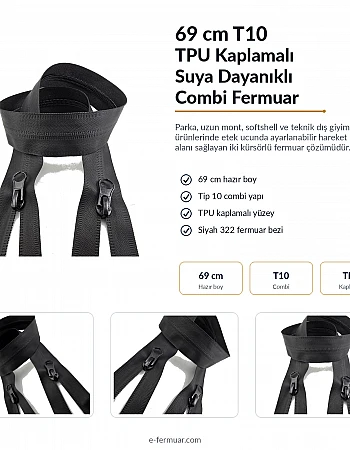
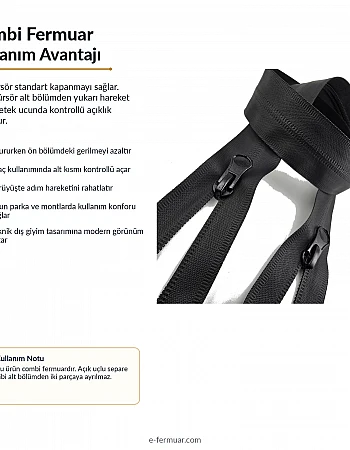
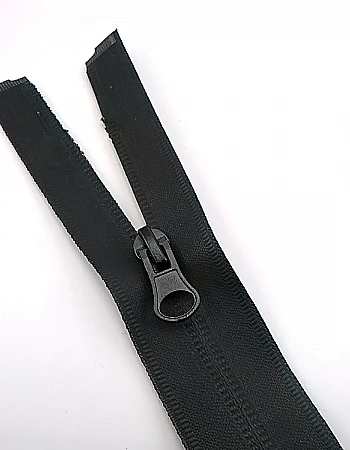
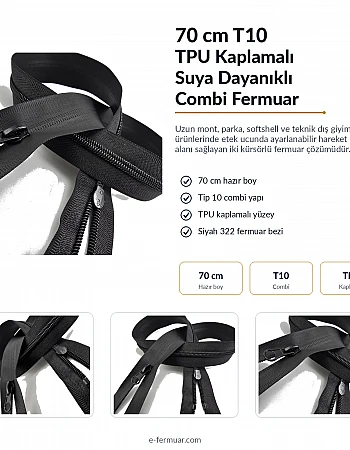
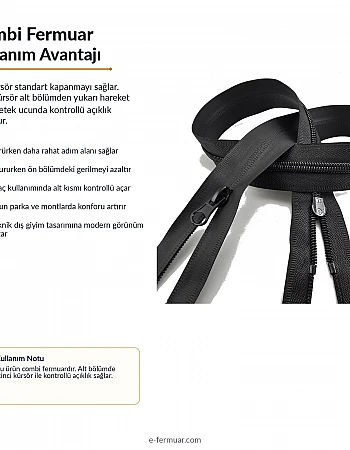
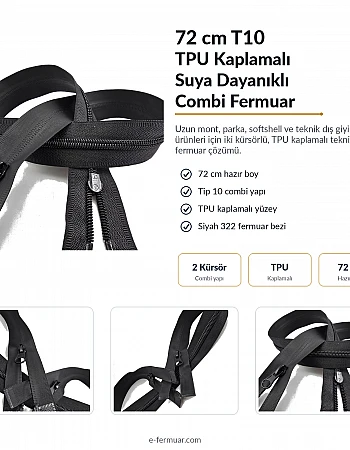
A two-way or combi zipper uses two separate sliders, separates completely and can open from the lower section.
Separating and lower-opening operation must not be combined into one filter value.
Coated Continuous Chain Production
Coated continuous chain provides length flexibility for bags, cases and technical textile products. After cutting, compatible sliders and secure end finishes are still required.
Slider consumption should be calculated according to whether each finished product requires one or two slider bodies.
Finished-Sample Inspection
- Does the zipper length match the finished pattern?
- Does the slider operate smoothly along the full closure?
- Is the film damaged during sewing?
- Do needle holes allow moisture entry?
- Does the insertion pin enter the box correctly?
- Do both combi sliders operate in the correct directions?
- Does the coating remain stable through curves and bending?
- Does the appearance remain acceptable after care testing?
Other Components Affecting Water Protection
- Water resistance of the main fabric
- Thread and needle holes
- Seam tape or welding
- Storm flap construction
- Slider junction gap
- Top and bottom zipper ends
- Corner and curved construction
Common Manufacturing Errors
- Do not guarantee full waterproofing without verified test data.
- Do not infer temperature or chemical resistance from TPU or PU names.
- Do not treat separating and combi zippers as the same construction.
- Do not confuse two slider bodies with one double-pull slider.
- Do not advertise reflective or PVC products unless they are actually supplied.
- Do not claim suitability for diving or protective workwear without certification.
- Do not apply uncontrolled heat directly to the coating.
- Do not begin bulk production without a finished sample.
Frequently Asked Questions
How should a workshop test a coated zipper?
Sew the zipper into the real fabric and test opening cycles, bending, film damage, moisture entry through stitching and the intended care process.
Does a water-repellent zipper waterproof the finished product?
No. Fabric, stitching, slider gaps, zipper ends and installation together determine the finished protection level.
What is different about a combi coated zipper?
A combi zipper has two separate sliders, separates completely and can open from the lower section.
Which slider is required for coated continuous chain?
The slider must match the actual coil profile and coating construction. A shared nominal size does not guarantee compatibility.
Is seam tape required?
It may be required depending on the protection target and product construction. Needle-hole protection should be assessed on a finished sample.
Can TPU coating be used at every temperature?
No. Temperature suitability depends on the actual film formulation and technical data. Unverified general temperature ranges should not be used.
Can the coating be damaged during production?
Yes. Needles, presser feet, sliders, high heat, sharp curves and abrasive processes can damage the film.
Last updated: July 22, 2026
Business: E-Zippers — zipper, slider and textile accessory supplier, Istanbul, Türkiye.
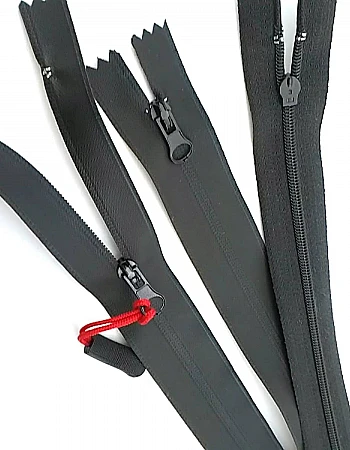
-1-350x450h.webp "17 cm 6.69\" Waterproof Zipper | Short Technical Zipper for Bags and Jackets | ZP00017PR")
-1-350x450h.webp "17 cm 6.69\" Waterproof Zipper | Short Technical Zipper for Bags and Jackets | ZP00017PR")
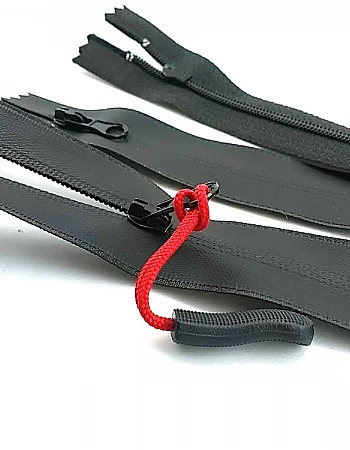
-1-350x450h.webp "70 cm / 0,76 yrd Waterproof Zipper T10 F0006TPU")
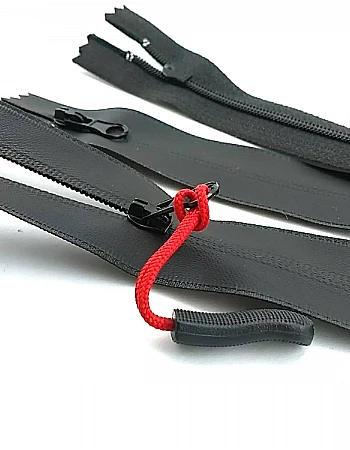
-1-350x450h.webp "Waterproof Zipper 73 cm TPU Combi NC0073SG")
-1-350x450h.webp "Waterproof Zipper 73 cm TPU Combi NC0073SG")
-1-350x450h.webp "24 cm Waterproof Zipper P00024PRC")
-1-350x450w.webp "24 cm Waterproof Zipper P00024PRC")
-1-350x450h.webp "Waterproof Strip Zipper PU #5 - SRTSGTT10")